
The Best Authentic Greek Salad

Juicy red tomatoes, crisp cucumber, sharp onion, olive oil and of course … feta. The one and only famous authentic Greek Salad also known as Village Salad and in Greek: Horiatiki. This is the real thing, do not accept imitations of so-called “Greek Salads”. Straight from Greece this salad is full of flavor, nutrients and the goodness of summer produce!
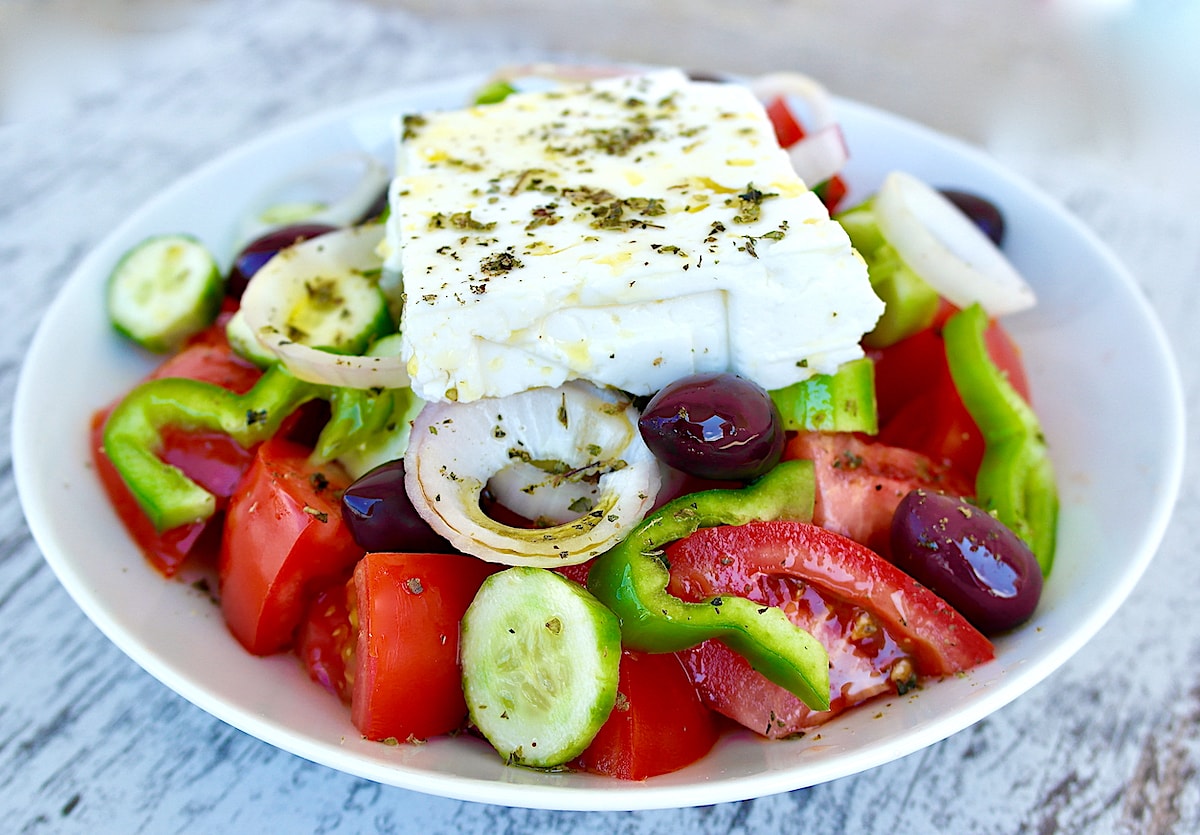
The Greek salad is one of the most popular and well-known Greek dishes outside and inside Greece. Greeks love the horiatiki, which means village in Greek. In the summer months it is present on most Greek tables at home and at the tavernes.
The basic Greek salad is made with tomato, cucumber, olive oil, olives and feta and there are variations around Greece. For example on the islands another white soft cheese is used instead of feta cheese and in Crete there is the well-known dakos; tomato and feta (or other local white cheese) piled on a large barley rusk that has been soaked with a bit of water and olive oil.
Before we go on with the recipe, we need to make some clarifications and correct some misconceptions.
How to Make the Best Greek Salad
Here are some rules of the Greek salad:
- There is no lettuce or any other leafy greens in the salad.
- The salad is not mixed before it is served.
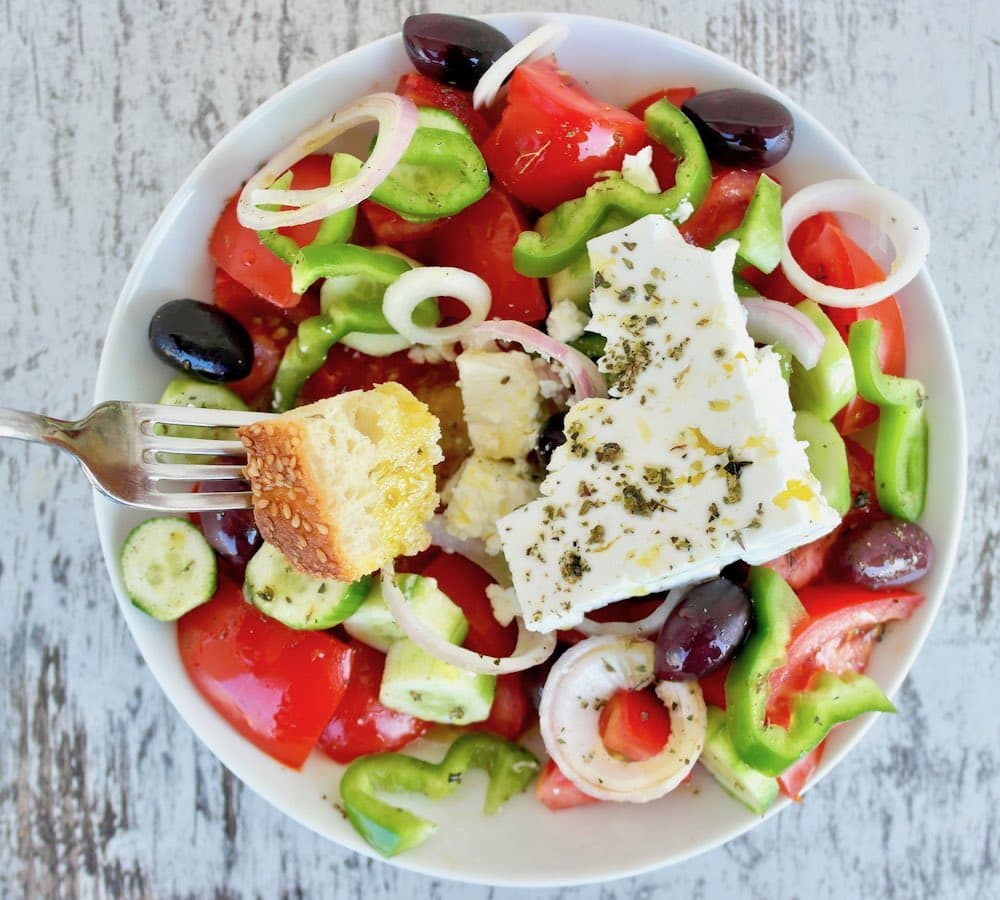
- The feta cheese is not cut in cubes but rather a large piece is placed on top of the salad.
- The tomato and cucumber should be cut in fairly large pieces not small cubes.
- Typically green pepper is used in the traditional Greek salad.
- Olives are added whole not sliced.
- The salad is served with bread, not pita.
- The salad is served in a shallow bowl; do not serve it in a deep bowl.
- Use the best ingredients. As with most simple dishes, the horiatiki needs excellent ingredients. Make sure you have extra virgin olive oil, in season ripe tomatoes, juicy Greek Kalamata olives, good fragrant oregano and real feta (Greek) cheese…
- Some folks here in Greece do not add vinegar. Vinegar is added due to the cucumber (mostly in homemade Greek salads). The women in my family added it, but for an outside resource you can check the Tselementes cookbook (a classic and one of the first widespread Greek cookbooks) also mentions vinegar.

Greek Salad Ingredients
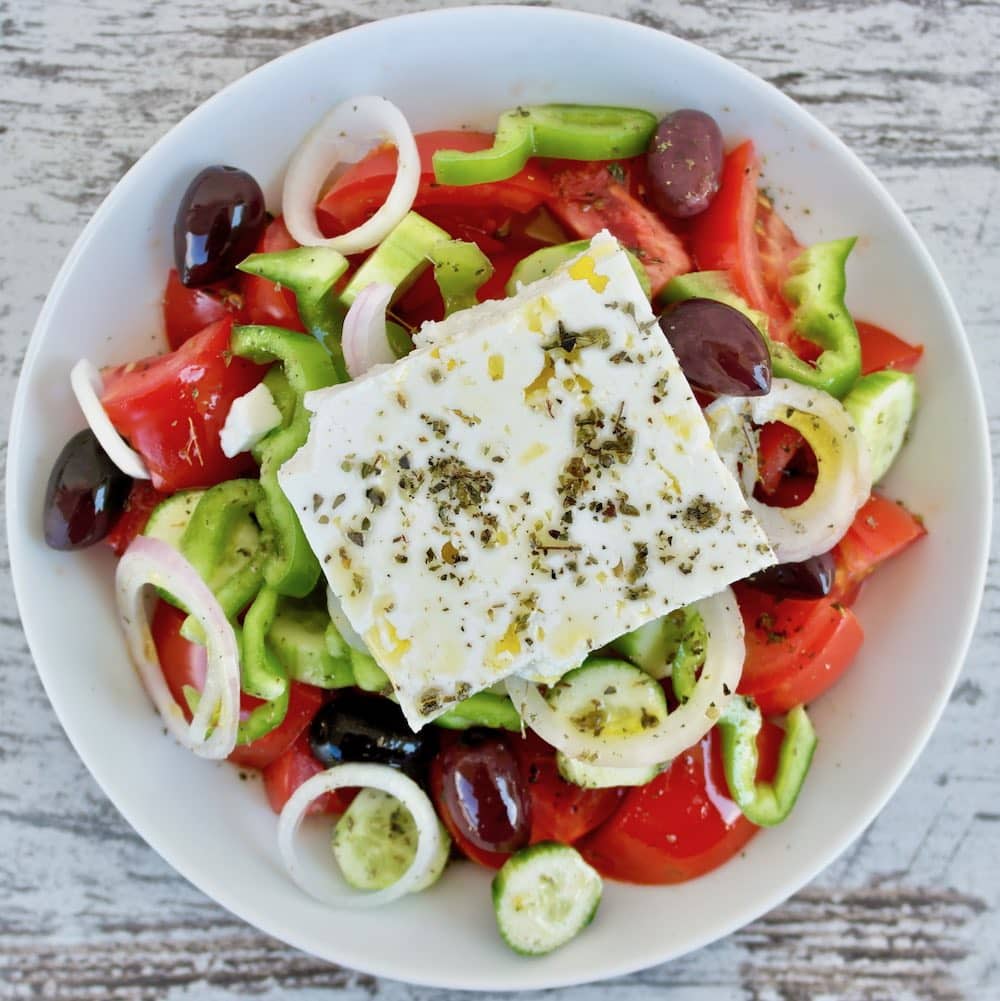
The ingredients that go on the Greek salad are basic but they must be in season and good quality
- Extra Virgin Olive Oil: Get the best and freshest olive oil you can get your hands on
- Ripe tomatoes
- Cucumber
- Red Onion
- Green Bell Pepper
- Kalamata olives (do not use those black canned olives- California style), they have a completely different flavor and are not processed naturally.
- Greek Feta Cheese. Real feta is Greek and is acknowledged as that by the European Commission. Check out this post on how to buy good feta and what good feta should look like and taste like.
- Dry Oregano
- Red wine vinegar
Greek Salad Dressing
So you want to know how to make a dressing for the Greek Salad? It is super easy. You actually do not make any dressing beforehand, you just drizzle extra virgin olive oil on the salad and a bit of vinegar. Some Greek actually only add olive oil! So just to clarify: a traditional authentic Greek salad does not have any type of dressing like the ones I see on various online recipes: there is no mustard, no lemon and definitely no garlic.
If you do want to make the dressing separately , you can make it as follows:
In a jar mix 3 parts olive oil, 1 part red wine vinegar
How to eat a Greek salad
1. With your fork break the big chunk of feta.
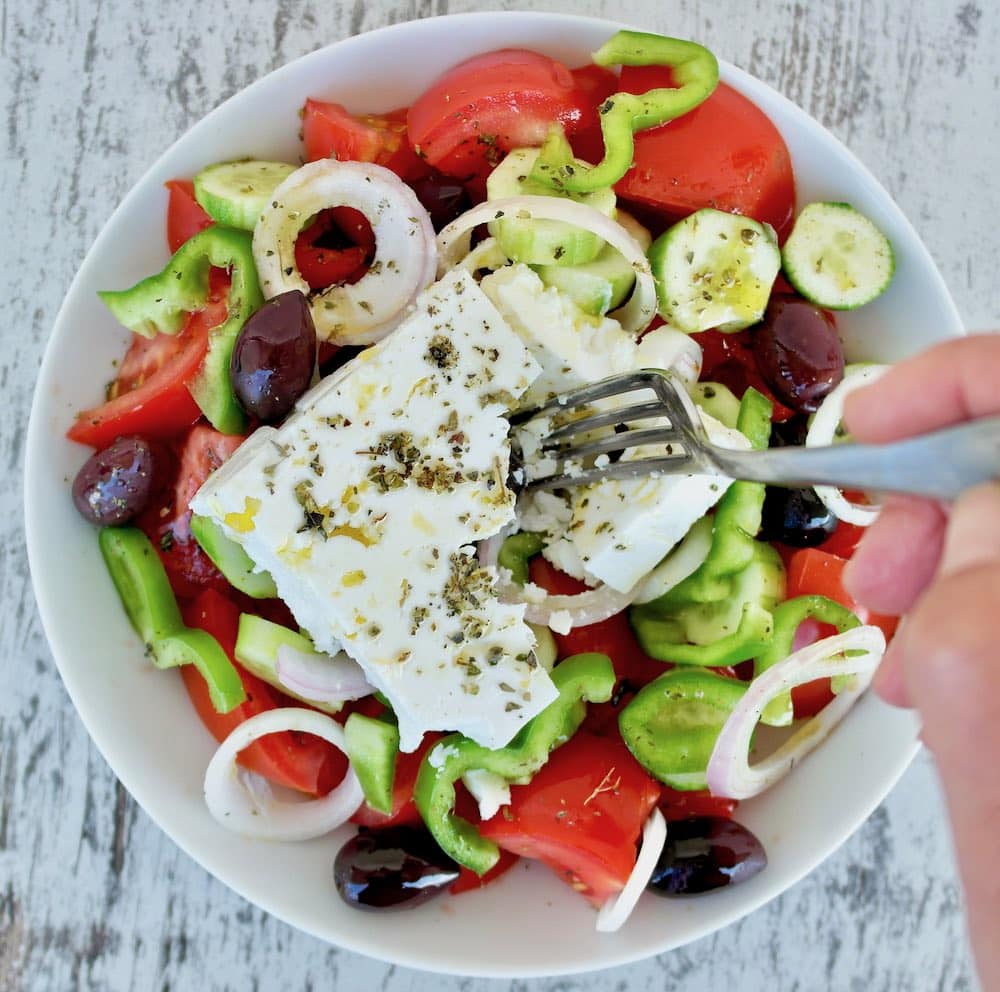
2. With your fork grab a piece of feta, a tomato and whatever else you can manage and eat it.
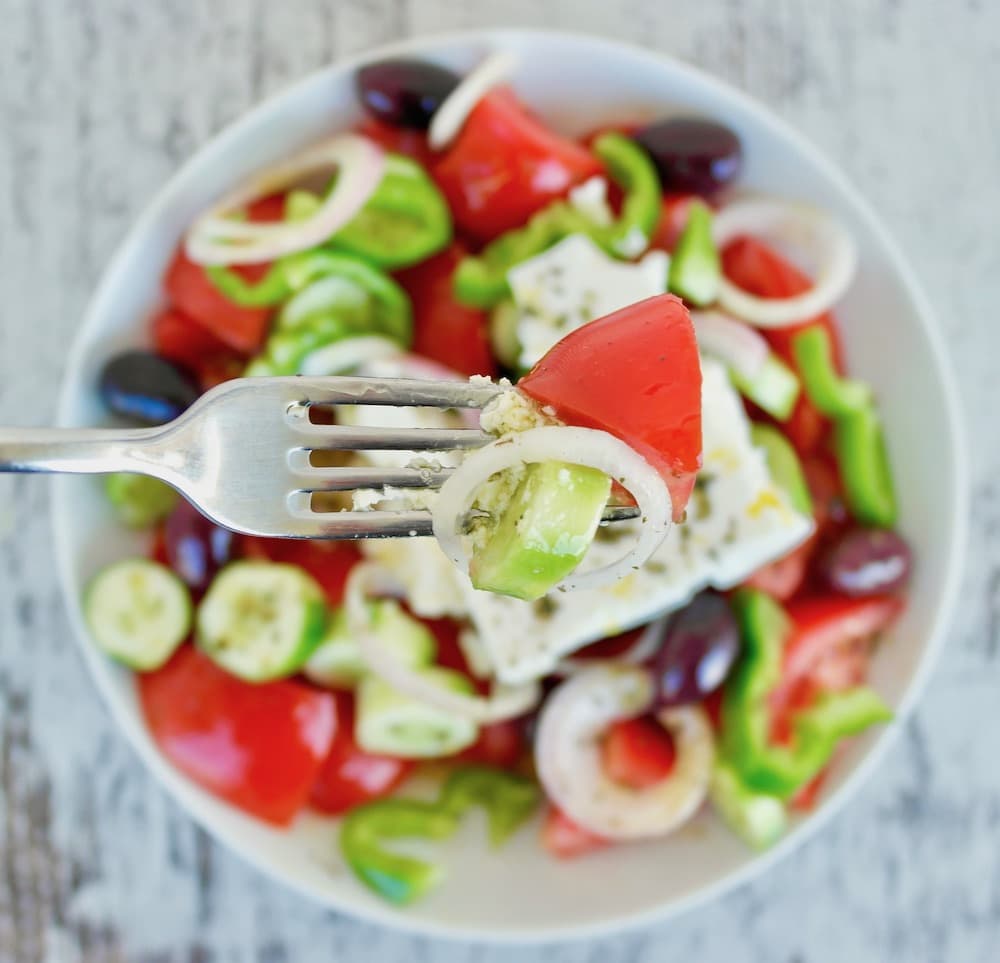
3. If you want to be polite you can spoon out a serving on your plate, but the beauty of the Greek salad is that it is best consumed directly from the serving plate. That way you have a choice of the different combinations you can eat with your fork; tomato and feta or cucumber, pepper and olive? The combinations are endless. Why limit yourself to a small serving on your plate? I personally cannot enjoy a Greek salad if I can’t just eat it directly from the serving dish.
4. If you’re really comfortable with the other people at the table, grab a chunk of bread (with your fork-unless you are alone) and dip it in the leftover mixture of olive oil, juices from the tomato and crumbles of the feta.
What to Serve with a Greek Salad
The Greek salad is a meal in itself; vegetables, healthy fats, protein from the cheese, it’s got you covered. You do not have to necessarily have to serve it with anything. I often have for lunch with a Cretan barley rusk or some whole grain bread. Having said that, in the summer in Greek homes a Greek salad is served almost everyday with whatever food has been prepared that day, with the exception of vegetable casseroles. For example pasta is always served with a Greek salad in the summer, same goes for any type of meat or fish.
Nutritional Value
Juicy red tomatoes, crisp cucumber, sharp onion, olive oil and of course … feta. I love the horiatiki salad, because it is healthy and almost decadent at the same time, just like most Greek food.
The horiatiki salad that usually serves as an appetizer, can be an excellent main course, especially in the summer. After a day on the beach, a horiatiki salad accompanied with some crusty bread and a glass of wine hits the spot. But this salad is not only about looks, it has substance too. Rich in fiber and antioxidants due to a combination of tomato, onion and olive oil. Feta cheese is the perfect complement, providing the necessary protein. How many calories? A whole horiatiki salad will provide you with about 600 calories, 100% of your daily vitamin C needs, and 50% of vitamin A (in the form of beta-carotene) and vitamin B2.
Authentic Greek Salad
Ingredients
- 2-3 tomatoes
- 1 medium cucumber
- 5-6 Greek Kalamata black olives
- 1/2 small onion
- 1/2 small green bell pepper
- 1 chunk of feta about 2 to 3 ounces
- 6 tbsp Extra virgin olive oil + more for drizzling
- 1 tsp dry oregano
- 3 tbsp Red wine vinegar
- Salt
Instructions
- Cut the tomato in wedges-do not cut in cubes. If the tomato is large cut wedges in half.
- Peel the cucumber and cut in slices that are about ½ inch thick, you may cut the rounds in half.
- Slice onion and green bell pepper in thin slices.
- Put tomatoes and cucumbers in a shallow bowl and combine. Place the thinly sliced onion and pepper
- on top. Add the olives. Sprinkle with oregano.
- Drizzle with some olive oil and a splash of vinegar.* Add some salt to taste.
- Place a piece of feta on top and sprinkle the feta with oregano and another drizzle of olive oil.
Notes
SAVE THE RECIPE FOR LATER AND PIN IT!
Photos by Elena Paravantes All Rights Reserved

I loved this salad! What would you recommend as a substitute for feta my husband hates feta and the olives. We are Mexican so I was thinking for his salad maybe a crumbly Mexican cheese he likes and avocado instead of olives.
There is nothing to touch this recipe – absolutely perfect !
This is absolutely the Best! I have made it so many times for guests, and everyone really enjoys it!
I accompany it with Kalimata olive bread, and a good Rose wine
Delicious , Even though I am not a fan of green peppers but I enjoyed it in this . Lovely ,fresh and tangy perfect accompaniment to my lamb steak
Fantastic, thank you for such a clear and concise description. We used to visit Greece as a family when I was a child and the memories of Greek salads in tavernas by the harbours are absolutely treasured!